

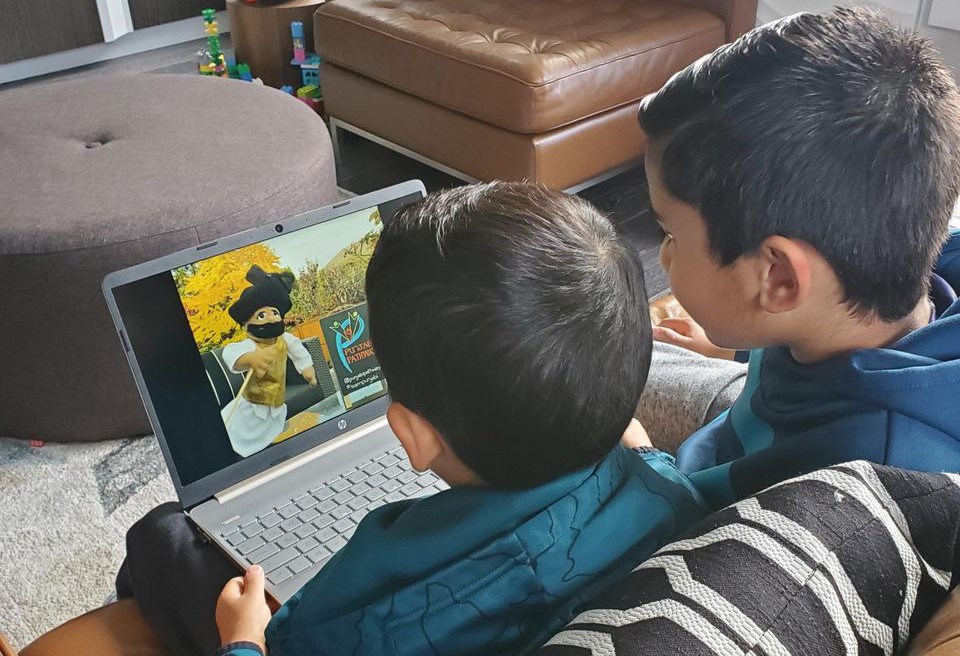
You speak to them in Punjabi. They answer in English. Every time.
It’s one of the most common things we hear from parents before they join us, and if it’s happening in your house, we want you to know two things: you haven’t failed, and it’s not too late to change it.
Why this happens (it’s not you)
Kids build a “listening” vocabulary long before a “speaking” one, that’s just how language works. But if English is the language of school, friends, and screens, it becomes the easy choice, and Punjabi quietly turns into a language they only receive, never produce. The understanding stays. The confidence to speak doesn’t get built.
It’s not a sign they don’t care about the language. It’s a sign they haven’t had enough low-pressure chances to actually use it out loud.
Why it’s worth pushing through
Speaking their heritage language isn’t just about grammar and vocabulary, it’s tied to how kids see themselves, and there’s real research behind that.
- It’s a direct line to family. Studies on heritage language maintenance consistently find that a shared language strengthens communication between children and extended family, and that grandparents in particular play a central role in passing the language on (1).
- It builds real identity, not just knowledge. Researchers have found that children who maintain proficiency in their heritage language tend to develop a stronger, more secure sense of ethnic identity, which is linked to higher self-esteem (2). Kids who feel comfortable in both their heritage culture and the culture around them also tend to have a broader outlook and more opportunities open to them (2).
- It’s their access point to culture. Researchers describe heritage language as one of the main ways children access their heritage culture in the first place, the two reinforce each other (1). Family stories, sayings, songs, and jokes rarely translate cleanly. Understanding isn’t the same as being in it.
- The cognitive benefits are real too, but they come from speaking, not just listening. Psychologist Ellen Bialystok’s research (York University) has repeatedly found that actively managing two languages strengthens attention, working memory, and cognitive flexibility in children (3). The advantage grows the more a child actually uses the language, not just hears it.
How we get kids from nodding to talking
This is exactly the gap we built Punjabi Pathways to close. Our classes for ages 4-17 aren’t lecture-style, they’re built around games, songs, and back-and-forth conversation with other kids their age, so speaking Punjabi feels like play, not a test. Small groups mean every child actually gets a turn to talk, not just listen.
One parent told us their son was sad when a session ended because “it’s so much fun.” That’s the reaction we’re aiming for, because a child who’s having fun speaking Punjabi will keep doing it.
If this sounds like your house, you’re not behind. You’re right on time.
See which class fits your child →
Sources
- Family and Heritage Language Maintenance, research review, McGill University.
- Meyer (2006), as cited in The Importance of Maintaining a Heritage Language while Acquiring a Second Language, Wayne State University.
- Bialystok, E. (2015). Bilingualism and the Development of Executive Function: The Role of Attention. Child Development Perspectives, 9(2), 117-121.

Gurjit Pattar
Gurjit Pattar is the Director of Curriculum and Operations at Punjabi Pathways. She is an award winning educator with over 23 years of experience teaching at the elementary and high school levels. Gurjit holds a Master's degree in Education, specializing in curriculum and instruction. In the past, she has helped develop curriculum for the BC Ministry of Education. Gurjit has also worked with the Punjabi Language Education Association of BC, advocating for the prominence of the Punjabi language being taught in public schools alongside other languages. Her Master’s action research project focused on equipping non-native speakers in Punjabi language classrooms with the skills and confidence to speak in their heritage language. This work inspires Gurjit to create engaging and confidence building lessons that make language learning accessible and enjoyable for all students.


